Workshop – “Let’s talk about confidence and navigating conversations around being recorded”
The prevalence of online working has resulted in recorded assignments becoming our “new normal”. With a year in hindsight it’s time to reflect on our practice about the feelings we have, and the things we can consider when our work is subject to recording.
Wednesday 19th May 2021
6.30pm-8pm
Held on Zoom – Free.
BSL Interpreted and captioned (on request if attending)
Those that are comfortable with this topic and feel they can contribute to the conversation are also welcome, as well as those who would like to explore this topic more. All information within the workshop will be confidential and will help build on further workshops and any identifying training opportunities.
The prevalence of online working has resulted in recorded assignments becoming our “new normal”. With a year in hindsight it’s time to reflect on our practice about the feelings we have, and the things we can consider when our work is subject to recording.
Wednesday 5th May 2021
6.30pm-7.30pm
Held on Zoom – Free.
BSL Interpreted and captioned (on request if attending)
Those that are comfortable with this topic and feel they can contribute to the conversation are also welcome, as well as those who would like to explore this topic more. All information within the workshop will be confidential and will help build on further workshops and any identifying training opportunities.
“The event will be recorded” to “we are going to start recording”.
Where do we stand on being recorded and are we confident in our decisions?
March 2020, lockdown. We all know how the profession had to quickly adapt and become accustomed to a new and innovative way of working. I already worked in a VRS setting pre-pandemic alongside my face-to-face work. Therefore, working in this manner was not completely new and I understood the finer details that went along with working in a 2D frame (although some technical upgrades were much needed).
What transpired as being new was the added option for clients to hit record on my work, whether that was for broadcast/live stream in real time or to be kept for later viewing on a different platform. One of my first assignments where I was asked to be recorded was at the start of lockdown; April, where a series of events were set up by a charity to support professionals in the media industry, output was live streamed and recorded for later viewing on social media platforms (public/closed groups) and the audience were familiar to me. I agreed to the conditions of the assignment because I am comfortable with my work being recorded, I understood the nature and the context of the assignment and why it was being recorded. Most of these events were pro-bono. Almost a year later, I was approached and asked if clips could be used from one of those sessions, as one of the presenters had hired a digital manager to promote their brand. I rejected this request. The assignment I undertook was based on the brief described above and not for any other purpose. We have a right to say “no” and “yes”. Saying yes would mean I lose any control of how that material is used, and that is something that, as a profession we must get used to understanding and also explaining to the people we work with.
This was the first of many assignments that followed the same trend; “It’s being recorded.” I quickly realised the increase in recorded assignments highlighted that I needed to be better informed about my practice if this is something that will eventually become the norm. Can recordings benefit the profession? I thought so, as I used some recorded assignments for my own professional development, which allowed me to hone in on my skills to enter a new domain. (At this point I want to thank my network and the people I call upon for advice and guidance. I can imagine an eyeroll and ‘here she goes again’ every time I have a question).
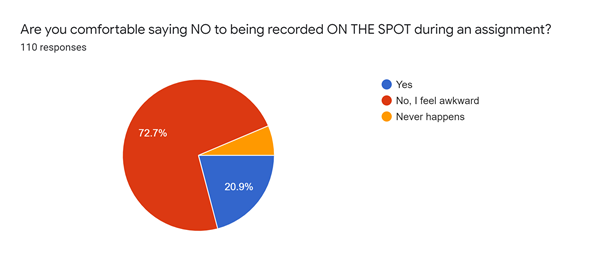
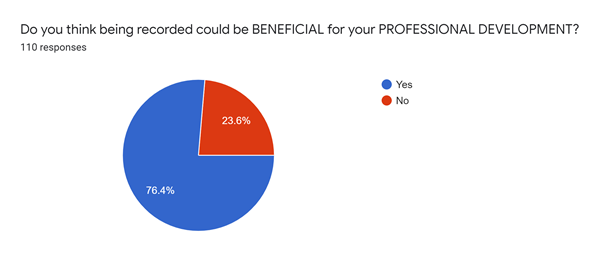
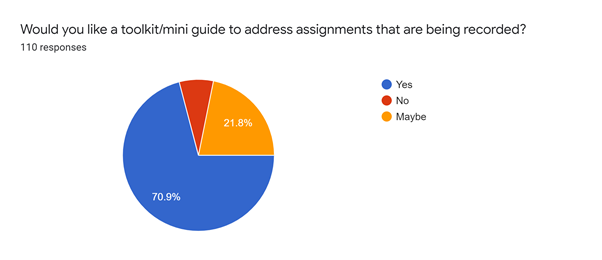
My curiosity led me to conduct a small snapshot Google Forms survey of 110 registered interpreters and translators (fully qualified and trainees) where it was highlighted that 87% of respondents have seen an increase in assignments being recorded. 76% also believe being recorded could be beneficial for their professional development. The increase in recorded work reflected the number of questions I had seen and continue to see around this topic in professional groups/posts within the profession. This topic is complex, and I am only scratching the surface. Over 70% of all respondents are not comfortable saying “no” when they are put on the spot. 85% of the respondents (RSLIs and TSLIs) that currently do accept work that is recorded feel awkward to say “no” when they are suddenly asked. What will it take to get members of our profession to feel more comfortable to say “no”?
Interpreter’s hesitancy to be recorded stems from a profession that is not able to watch without judgement. Some respondents felt a sense of ‘dread’, ‘terror’ and ‘judgement’ at the thought of an assignment being recorded. Imagine working and experiencing those emotions, alongside having to process between two languages. Yet, our deaf translator colleagues are unphased, as most respondents were confident to say “no” on the spot and ‘fair enough’, as they’ve ‘been doing this work pre-COVID-19 and thus there hasn’t been a big shift’. It is acknowledged that both the recording of live and pre-recorded work has risen, but for the moment I want to focus on recorded live work.
It is important for me to state, we should not be recording our colleagues and other professionals we work with without their consent. It is worryingly happening. Video conferencing services are built in a way to take account of GDPR. If you are bypassing those and using a different device to record work, it is unethical. It also becomes illegal to then publicise or share such data with third parties without consent.
The pandemic has seen most, if not all, parts of our life transition onto an online platform in some way, shape or form. If we cannot be privy to something in real time, we hope that we are able to have access at a more convenient time. The work we undertake reflects this, whether that is a lecture, an evening seminar, a workshop or a comedy event. The list is endless. Survey participants gave many examples of how having our work recorded could be a positive experience: One respondent interprets regular university lectures and ‘they’re specific about what the recording is being used for and where it’s going’ and this lends to a positive experience. We are now being recorded, so ‘minutes in a meeting can be summarised and distributed accurately.’ These are stored temporarily and deleted when no longer needed. One respondent was able to use a recording as evidence of interpreting to qualify and become an RSLI, as the event was posted on social media.
A deaf friend said, ‘with the visibility of language, comes access.’ With the need for language to be accessible we gain more exposure and exposure raises the need for ‘accountability, [which] raises your game’ states one respondent, after having a positive experience of being recorded. Some respondents have used these opportunities as a way of improving their skillset and ‘unlearning bad habits’. It was identified that 80% of respondents are happy to decline being recorded prior to an assignment. So, have we become a complacent profession? Respondents are deterred from accepting recorded assignments for many reasons, including ‘lack of confidence’, ‘not enough time to prep’ and ‘anxiety’, as assignments can ‘become very public’ to a ‘hyper-critical future audience’. I wonder if the trauma interpreters anecdotally talk about through the qualifying process has become a barrier that recorded assignments trigger.
What happens when you do not know that you are being recorded? One respondent said that suddenly the ‘zoom recording light has flashed on [without] warning… and liaising with the organiser is awkward’ Again, it is important to navigate conversations holistically when you feel you are not able to, without the fear of causing a fuss. Recently, a co-worker and I were booked by a deaf client for an academic presentation. We received comprehensive preparation materials and liaised extensively with the team organising the talk. At no point was there a mention of this being recorded. Having worked with this client before, recorded assignments are normally addressed at the point of confirmation. 10 seconds before the talk starts, the co-host states ‘let’s record it’. “No”. What followed was a quick message to my co-worker and the client to clarify that they can record the speaker but not the interpreters. Our interpretation was targeted at a specific person on that day using specific signs and the client was the paying entity. Humans by nature do not want to rock the boat and interpreters by default are trained to blend in and ‘just interpret’. It is no longer feasible to answer an email with ‘I’m free’ and then ask questions later. Terms and conditions, media release forms, NDA’s, confirmations and agreements of what is expected from an assignment are all important but not enough. We need to articulate ourselves and understand each assignment that we do. So, when we are placed in situations such as the one above, we can then navigate ourselves with confidence and conviction. As a profession, I honestly do not think we are there yet and, as a profession we often struggle to quote for work when we are asked to be recorded.
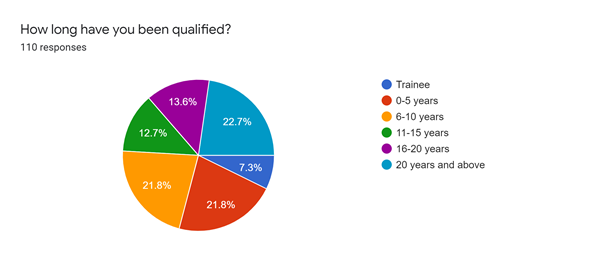
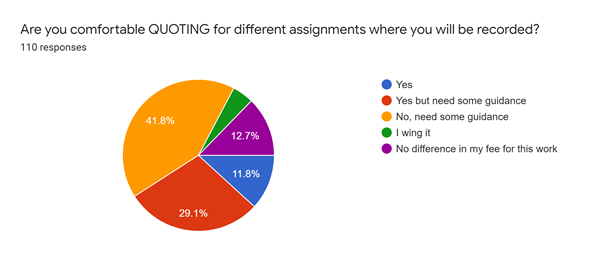
11 out of the 64 respondents who currently accept recorded work are comfortable with quoting. 22 are comfortable but need some guidance, 18 are not comfortable and need guidance, 9 see no difference in their fee and 4 wing it. I assumed that with more experience in interpreting, you would have some level of understanding, as to what to quote, but this was not my finding. Someone qualified between 0-5 years will wing it just as much as their colleague who has been qualified between 11-15 years. A TSLI would not quote differently just like an RSLI who has been qualified for over 20 years. Who has the magic answer? Of course, like many questions in interpreting, the answer is it depends.
The below graph highlights all 110 respondents comfortability with quoting, irrespective of them currently accepting recorded work:
Here is an example; A half-day conference that would take place face-to-face is different to a half-day conference that will be recorded and then used as evergreen content on a website for future reference. The time required to facilitate that interpretation along with the cognitive load, preparation time, pre chat meetings with your co-worker and the production team for the day, is not and should not be the same fee. ‘You have to be worth paying’ was something I was told whilst training to become an interpreter. Interesting choice of words at the time. I carry this comment with me for many reasons, mainly because when I engage with someone that requires my service, I look at what skills I can offer and in what context and quote accordingly. Your fee is reflective of a service that you provide, and a part of that service is understanding your work in a holistic manner. This also means just because you are being recorded does not necessarily mean an additional fee should be applied. Understanding each assignment in its entirety will enable interpreters to make more confident choices. I can understand why over 70% of respondents would like some sort of guidance that can address assignments that are being recorded.
I am in a position where my network allows me to call upon people to enable me to become better informed, but I also understand that for some it is not easy. What I hope can come from talking and discussing this topic is either a system that enables us to question more from the get-go and understand what is required from us before entering unchartered waters. 30% of all respondents would feel encouraged undertaking work that is recorded with some guidance and support.
In conclusion, I expect recording of our work is something that is here to stay, with our new normal. There is a need to be better informed about the work we do. We need to be open to educating and engaging those who call upon us for our services. There are areas of work, which have seen an increase in demand, for example media, events and education. Each of these requires different approaches, as the outputs are different. This small-scale survey has brought to light that SLI’s in general need to understand their work better and question more before getting caught in a clickbait response to assignments. We can no longer respond with brief queries, arbitrary fees and allow others to take on that labour. A deaf client, working in academia agrees that we ‘need to talk more with deaf clients and communities to understand the full picture of these issues, including the (often invisible) labour experienced by deaf people working with interpreters’.
I hope to create something tangible, such as informal workshops and simple templates with colleagues. Confidence needs to be built among our peers but that can only be done by addressing the issues above. A breakdown of what different recorded and non-recorded assignments require will nurture a new way of thinking. This in turn could make recorded assignments easier for interpreters to accept or decline.
 SHARAN THIND